Torricelli’s Trumpet
Forms of the World, Part One

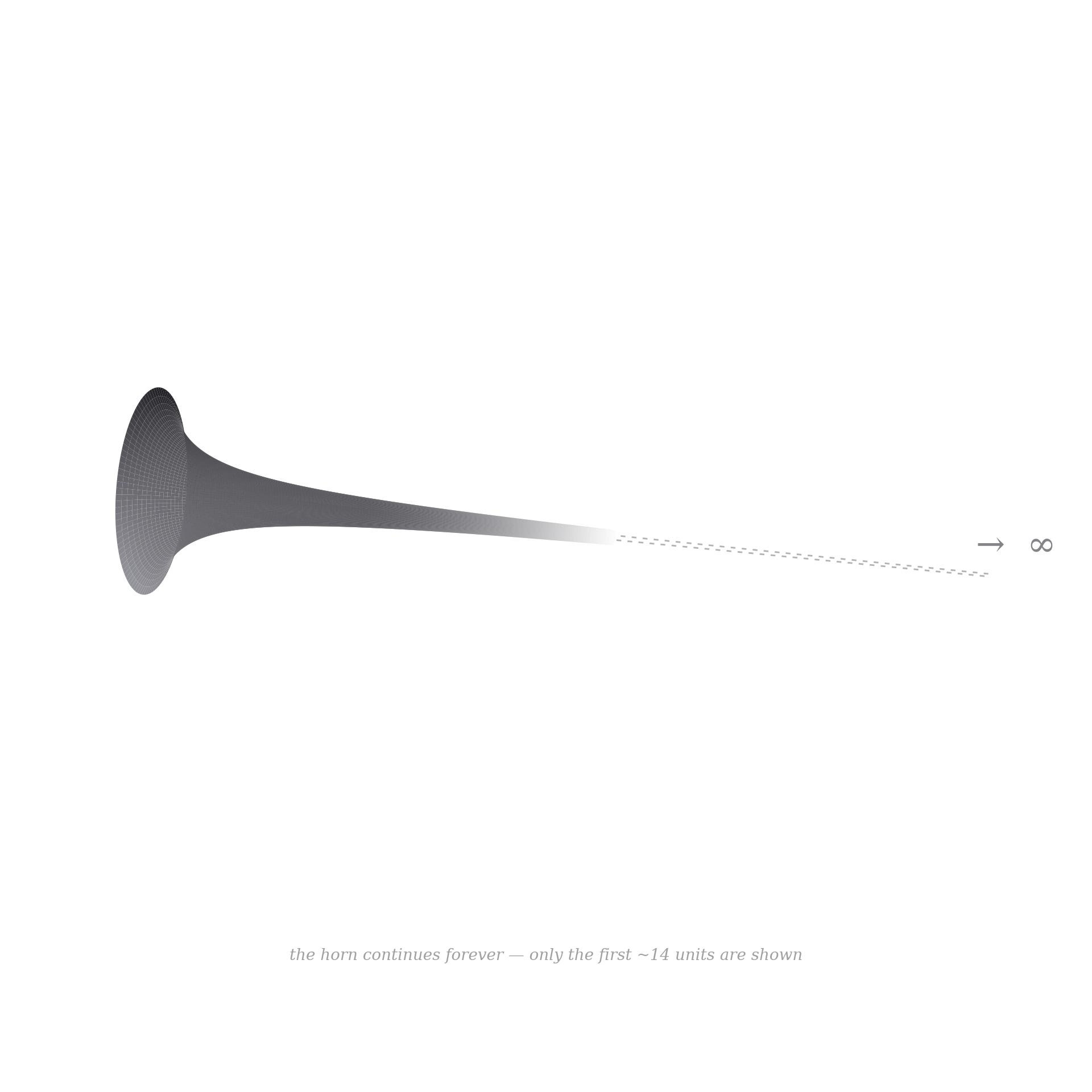
I was reading R. F. Kuang’s Katabasis — her dark academic descent, in which two Cambridge graduate students travel to Hell to retrieve their dead advisor and discover, by degrees, that Hell is Cambridge — when I came across a mathematical shape I didn’t know.
Torricelli’s Trumpet. Also called Gabriel’s Horn.
Kuang seeds her version of Hell with logical paradoxes the way Dante seeded his with sinners. Among them: this trumpet. I stopped reading, looked it up, and the looking-up turned into this piece — and, I now think, a series.
Here is the shape.
Take the curve y = 1/x, starting at x = 1 and stretching out to infinity. Rotate it around the x-axis. What you get is a horn — narrowing forever toward a line it never touches, and opening at the other end into a bell.
Now measure it.
The volume — what you could fill it with — is finite. It works out to exactly π. You could pour the entire inside of the trumpet into a wine glass.
The surface area — the inner wall, where any liquid you poured in would press — is infinite. There is more surface inside that small finite cup than exists in all the oceans of the earth.
This is the paradox. Torricelli, a student of Galileo, found it in 1641. His contemporaries didn’t know what to do with it. The shape violated something they couldn’t quite name — a working assumption about what a container is allowed to do.
The explanation, once you see it, is almost simple. As the horn narrows, its volume shrinks fast — each successive stretch holds dramatically less liquid than the last, in installments that sum to exactly π and stop there. Its surface shrinks too, but slowly — slowly enough that those installments, however small, never stop accumulating. Volume converges. Surface doesn’t. Same shape, two different rates, and one of them is on the wrong side of a mathematical line.
The popular version of the puzzle — that you could fill the horn with paint but never coat its inner wall — is a kind of sleight. Real paint has thickness; mathematical paint doesn’t. But the deeper point isn’t about paint at all. It’s just that volume drops away fast enough to land somewhere, and surface doesn’t.
And yet the paradox doesn’t leave when you’ve explained it. Something about it stays.
What does it know?
It knows, first, this: a thing can be small inside and unbounded at the edge. The interior of a life — what it contains, what it weighs, what it amounts to on any ledger you keep — can be modest. The surface of that same life, where it meets the world, where it touches and is touched, can have no end. The two are not in conflict. Encounter is the dimension that doesn’t show up on the balance sheet.
It knows, second, the asymptote. The horn narrows forever toward a line it never reaches. Every contemplative tradition I know of teaches some version of this. You don’t arrive at God, or at truth, or at love. You approach. The approach is the practice. The not-reaching is part of how it works.
It knows, third, the breath. A horn is an instrument. The shape holds finite air and lets out infinite sound. What’s poured in is bounded — one breath, one note, one person. What comes out doesn’t have to be.
And it knows, fourth — though this last reading is mine — something about a certain kind of vocation. To stand inside this shape is strange. You remain finite in your substance: one body, one day’s attention, one set of choices. The surface where you press against the world, though, has no edge. A word said in passing travels further than you can follow. A silence held badly reaches people you will never meet. Bounded selves, unbounded skins. What you carry inside, you carry outside — without end.
Torricelli’s discovery sat in the seventeenth century like a stone in a shoe. The math was right. The intuition was wrong. The gap between them didn’t close — and that’s why the shape has lasted. Not as a curiosity, but as a teacher. It does what good questions do. It stays open.
This is the first of a series. Others are coming — the Möbius strip and its single deceptive surface, the torus and its breathing return, the Klein bottle that has no inside at all, the strange attractor that produces pattern without ever producing prediction. Each of them, I think, knows something the world keeps trying to say.
I’m writing them down because, more and more, the most useful frameworks for the work ahead don’t seem to be new acronyms or new models. They’re old shapes — drawn carefully, sat with quietly, and allowed to teach what they’ve been teaching all along.
We start with the trumpet because the trumpet is the first instrument. It announces. It opens. It calls. Kuang uses it as a torment in Hell. I think it is also the shape of a vocation. The two may be closer than we’d like to think.
Pour what you have into it.
Listen for what comes out.
Richard Singer is CEO and Co-founder of Radically Human Ventures, the holding architecture for a portfolio of ventures restoring one billion lives to their fullest human potential by 2036. Through the leaders we form. Through the ventures we build. Through the integrity we hold.